Executive Summary - Specification and Supply Position
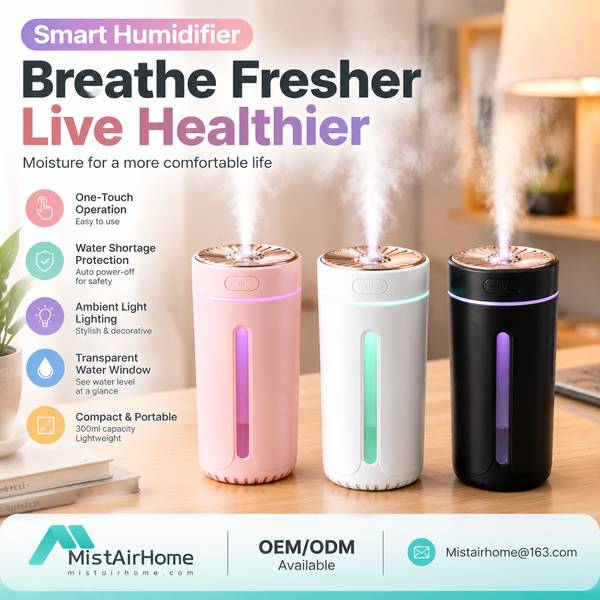
TL;DR - The Mistairhome WL-SM01W (STD) holds 415 mL and mists 40 mL per hour or 18.0 mL per hour, which is 10.4 hours and 23.1 hours per fill; it covers 11 sq m (113 sq ft) at a 2.6 m ceiling and measures 25.4 dB on the high step and 23.2 dB on the sleep step; it draws 3.3 W and takes its supply from USB-C 5V/1A, runs from a laptop port or a phone charger; the humidistat holds target band 30 to 80 percent in 5 percent steps, held within 3 percent over Wi-Fi 2.4 GHz with Bluetooth fallback for first pairing, and the voice path is Amazon Alexa and Google Home, plus Siri Shortcuts on iOS; no internal cell on this build; it weighs 436 g and measures 10.6 x 10.6 x 19.2 cm, and ships documented to CE / RoHS / FCC standards for import into Bangladesh. MOQ is 200 units per SKU with a 15-25-day lead time, FOB Shenzhen or EXW Longgang.
China Wanlin supplies the GoveeLife Smart Humidifier category as a direct manufacturer, not as a trading intermediary. The unit described below is one configuration out of 24 combinations (8 chassis x 3 SKU builds) that share a common misting family, a common tank and seal line and a common documentation set, so a distributor can build a coherent shelf from one source rather than stitching together unrelated suppliers. Every unit referenced on this page corresponds to a specific bill of materials held on file, so the figures below can be reproduced or independently verified at sample stage.
Full specification of WL-SM01W-STD:
| Misting method | Ultrasonic piezo disc at 1.7 MHz on a floating silicone isolator, cool mist, no heater in the path |
| Tank capacity | 415 mL |
| Mist output on the high step | 40 mL per hour |
| Mist output on the low step | 18.0 mL per hour |
| Run time per fill on the high step | 10.4 hours |
| Run time per fill on the low step | 23.1 hours |
| Coverage area | 11 sq m (113 sq ft) at a 2.6 m ceiling |
| Noise at 1 m on the high step | 25.4 dB |
| Noise at 1 m on the sleep step | 23.2 dB |
| Water type | Tap water or distilled; a demineralisation cartridge drops into the tank neck |
| Mineral dust handling | Cartridge optional, recommended wherever the supply is hard |
| Fill method | Wide top opening, filled in place from a jug |
| Battery pack | Not fitted, runs from the USB-C supply |
| Cordless run time | Not applicable, mains or USB powered |
| Charge time | Not applicable, no internal cell |
| Power input | USB-C 5V/1A, runs from a laptop port or a phone charger |
| Rated power on the high step | 3.3 W |
| Network link | Wi-Fi 2.4 GHz with Bluetooth fallback for first pairing |
| App platform | iOS 14 or later and Android 9 or later, live humidity trace and 30 day history |
| Voice assistant support | Amazon Alexa and Google Home, plus Siri Shortcuts on iOS |
| Humidistat range and accuracy | target band 30 to 80 percent in 5 percent steps, held within 3 percent |
| Control interface | Touch strip with three mist steps, sleep mode and a two, four or eight hour timer |
| Night light | Amber ring below 4 lux, dimmable to fully dark |
| Protection | Dry-run shut-off by tank float, tilt switch, overcurrent limit on the adapter |
| Scheduling | Seven day schedule with four events per day, states restored after a power cut |
| Dimensions | 10.6 x 10.6 x 19.2 cm |
| Weight | 436 g |
| Warranty | 12 months |
Shipping configuration: Standard build, 1 x USB-C cable, 1 x cleaning brush, instruction leaflet, retail box. Master carton holds 60 units. Stated lead time is 15-25 days from order confirmation and deposit. Misting discs, wicks and cartridges are repeat line items and are ordered separately from the appliance.
Why Buyers Are Sourcing This Category Now
Buyers in Bangladesh are not buying comfort so much as buying a stop to a specific complaint: a dry throat in the morning, static off a carpet, a child waking coughing, or white dust on dark furniture. Channel structure follows a stable pattern: importers take container volumes, regional distributors break bulk into pharmacy, hospitality and facilities supply, and online sellers absorb the mixed-SKU remainder that suits catalogue breadth.
Distributors handling GoveeLife Smart Humidifier lines consistently find that the repeat revenue sits in the consumable, in cartridges and wicks and replacement discs, rather than in the appliance. This is why the table above states figures by model rather than by marketing tier: a buyer comparing two SKUs needs the noise on the sleep step, the run time per fill and the water handling side by side, because those three predict both satisfaction and return rates better than any other set.
Wanlin serves Bangladesh through three programmes that suit different balance sheets. New partners start with sample evaluation then a mixed trial order. Established distributors move to scheduled container shipments with locked pricing windows. Brand owners run private-label programmes with their own artwork and manuals. In all three cases the factory documentation, including the certificates and battery files listed further down this page, references the specific model code on the order rather than a generic family certificate, which is the most common cause of customs delay in this category. For this configuration that means 18.0 mL per hour at 23.2 dB, holding 23.1 hours per fill across a 11 sq m (113 sq ft) room.
Engineering Notes - Humidity Control, Connectivity and Water Quality
Three engineering decisions separate this platform from the commodity end of the category. The first is where the intelligence lives. A unit that stops working when the internet does is not a controlled appliance, it is a remote control with a humidifier attached, so the target and the schedule are stored on the unit itself and the network is only a convenience. With the router down the closed loop keeps running to the last target, and when the link returns the logged trace backfills rather than showing a gap.
The second is what the sensor is actually reading, because that decides whether a target means anything. A humidity sensor sitting next to the mist outlet reads saturated air within a minute and shuts the unit down early, so the probe is placed in the intake path behind a baffle and calibrated at the factory against a reference hygrometer. A buyer can repeat the check in twenty minutes with a shop hygrometer, which is the only way a published accuracy figure means anything.
The third is the radio, and it is where cheap builds fail in the field. We specify 2.4 GHz rather than 5 GHz because it reaches through the two walls that matter in an apartment, we keep a Bluetooth path for first pairing so a unit can be set up where the Wi-Fi password is not to hand, and we keep the radio off the safety path entirely: dry-run shut-off, tilt and overcurrent protection are hard-wired and do not depend on firmware. On the WL-SM01W (STD) the figures worth carrying into the next order are the 415 mL tank, the 23.1 hours per fill on the low step, and the 23.2 dB reading on the sleep step.
Featured Deployment and Field Case Records
Three deployment records from the GoveeLife Smart Humidifier programme, each with the conditions that shaped it. Site detail is kept because it is the part that transfers: the water, the ceiling, the rota and the complaint are what decide whether a unit stays in service, and none of them appear on a specification sheet.
Case Study 1: Krakow, Poland
Deployment: A portfolio of 38 short-let apartments managed by one person across two districts
Timing: One year from March 2025
Short-let operators cannot visit every apartment, so anything that needs a physical check fails on cost. Remote status did the work here: the operator sees which units are low, which are off, and which rooms are drifting, then sends a cleaner only where it is needed. Guest mentions of dry air in reviews went from 11 in the first quarter to none in the third.
Case Study 2: Lahore, Pakistan
Deployment: A carpet showroom holding hand-knotted stock on open racks in a heated hall
Timing: Fourteen months from October 2024
Wool and silk lose flexibility in a dry room, and the showroom was seeing pile crush on display pieces. Holding 45 percent with an alarm protected the stock, and the owner asked for the same arrangement in his storage warehouse in the following season. The alarm mattered more than the output for a buyer who is rarely on site.
Case Study 3: Providencia, Chile
Deployment: A 96-bed care home on a narrow site where night staff cover three floors
Timing: One year from May 2025
Night staff decide whether an appliance survives in a care home, because they are the ones who refill it. The change that mattered was not the tank size but the low-water alert on a phone: the night round stopped including a check of every room. Refill labour fell to the point where the home extended the programme to the second floor in the same budget year.
The pattern across all three is that the deciding factor was never peak output. It was whether the tank lasted a full shift, whether the unit could be cleaned inside the time a round allows, and whether anyone complained about the noise or the dust. Those are the questions we ask before quoting. The WL-SM01W (STD) packs 60 units to a carton, carries a 12 months warranty and a 15-25 days stated lead time, and draws 3.3 W on the high step.
Brand reference note. Brand names and published comparisons referenced on this page belong to their respective owners, are reproduced only to identify the comparison class a buyer is searching for, and do not indicate affiliation, endorsement or sponsorship by those owners or by Wanlin. Wanlin publishes no third-party performance figures it has not itself measured on its own units under stated conditions, and recommends that buyers verify any claim against their own sample before placing volume orders.
Application Scenarios Across Bedrooms, Offices and Managed Estates
Four placement patterns cover most of the enquiries we see for this category. The useful observation is that each one is answered by configuration and placement rather than by buying a larger unit, which is the default reflex and usually the wrong one.
| Scenario | Room or site | What the site needs | What the unit does |
| SC04-HANDSFREE | Rooms where the occupant is holding something, standing far away or working in the dark | A phone in the hand is a control surface nobody has to reach for. | Voice commands set the target and the step, which is why this build is specified in treatment rooms and clinics where hands are occupied. |
| SC01-TARGET | Rooms where the brief is a humidity band rather than a mist setting | An output figure answers the wrong question when the buyer actually wants a room held at a number. | The humidistat holds a target band and the app records the trace, so a facilities team can show the room stayed inside the band instead of showing that a unit was switched on. |
| SC08-EMPTY | Holiday lets, cabins and seasonal villas that sit unoccupied for weeks | An appliance in an empty house has to be verifiable from somewhere else. | Remote arming holds a low maintenance target while the property is empty and raises it before arrival, with the log replacing the drive-out inspection. |
| SC05-MISTFREE | Hard water markets where an ultrasonic plume leaves minerals on dark surfaces | White dust is the complaint that generates the return, and no app feature fixes it. | The evaporative build leaves minerals in the wick instead of the air, and the app counts down wick life so the filter is changed before output falls. |
Two of these four are decided before the unit is switched on: whether the tank lasts the interval the site can actually service, and whether the cleaning task fits the round. For this configuration that means 18.0 mL per hour at 23.2 dB, holding 23.1 hours per fill across a 11 sq m (113 sq ft) room.
What a Factory-Direct Programme Changes for the Buyer
The practical advantage of a factory programme is flexibility in how the first order is shaped, not the unit price. A mixed container across three SKUs lets a distributor test a range without committing to full container quantities on unproven models, which is the single biggest risk reduction available to a new importer and one that intermediaries rarely offer because it complicates their own purchasing.
The second advantage is lead-time honesty. A stated lead time of 15 to 35 days measured from order confirmation and deposit, written on the proforma invoice rather than left open, is worth more to a buyer planning a season than a faster number that slips. Battery shipments add a documentation step at booking, which we handle but which needs a few extra days on the freight side, and we say so before the order rather than after.
The third is continuity. Tooling, mouldings and the documentation set stay the same across seasons, so a distributor who lists a model code this year can relist it next year without a new test round. On the WL-SM01W (STD) the figures worth carrying into the next order are the 415 mL tank, the 23.1 hours per fill on the low step, and the 23.2 dB reading on the sleep step.
Certification, Radio Compliance and Market Access
Four documentation errors account for most of the customs delay we are asked to fix, and all four are avoidable at quotation stage. The first is a certificate naming a family rather than the model code on the invoice. The second is a battery build shipped without UN38.3 and MSDS. The third is a manual in the wrong language for the destination. The fourth is a plug that does not match the destination.
None of those are engineering problems. They are paperwork problems, and they are the reason we ask three questions before quoting: which markets, which languages on the manual and the artwork, and whether any unit in the order carries a cell. Answering those three costs a buyer five minutes and removes the majority of the delay risk.
What we will not do is back-date a certificate or issue one against a model we did not build. A buyer who needs that is a buyer whose shipment will be stopped eventually, and the cost of the test is always smaller than the cost of the container sitting at the port. The WL-SM01W (STD) packs 60 units to a carton, carries a 12 months warranty and a 15-25 days stated lead time, and draws 3.3 W on the high step.
Unit Economics, Consumables and Order Sizing
Three numbers decide whether this line works for a distributor, and the first one is not the unit price. Freight is the variable most buyers undercount: at 0.165 cubic metres per master carton of 60 units, a 20 ft container takes about 128 cartons, or roughly 7,680 units, and a 40 ft container about 283 cartons, or roughly 16,980 units. Those are volume figures before palletisation and loading losses, so a buyer should treat them as an upper bound.
The second number is the consumable. A misting disc is a wearing part with a service life measured in months of continuous use rather than years, and hard water shortens it considerably. We suggest one spare disc per twenty units on a first order and one cartridge per unit where the water is hard, and both ride in the same container as the appliances.
The third is the cost of a return. In this category the majority of returns come from mineral dust, not from malfunction, and the cartridge that prevents them costs a fraction of the return it avoids. For this configuration that means 18.0 mL per hour at 23.2 dB, holding 23.1 hours per fill across a 11 sq m (113 sq ft) room.
Buyer Questions Answered
What is the minimum order quantity for a first smart humidifier order?
MOQ is 200 units per SKU for standard builds and 300 units for custom colour or private-label packaging. Mixed-container orders combining several models are accepted as long as each individual SKU clears its own minimum. The specification table on this page shows the exact build we ship for WL-SM01W-STD.
How is the noise figure measured, and what does it mean in a bedroom?
We measure at one metre in a semi-anechoic corner and quote the step, so the two published figures for WL-SM01W are 25.4 dB on the high step and 23.2 dB on the sleep step. The sleep-step figure is the one to compare, because it is the step a bedroom unit is left on all night. A buyer can repeat the measurement in a quiet room with a phone application and will get within a decibel or two.
Does this humidifier leave white mineral dust on furniture?
It depends on the water and on the misting method, and it is the single largest cause of returns in this category. An ultrasonic disc throws everything dissolved in the water into the air, so on a hard supply it leaves a fine white mineral film on dark surfaces within days. Two answers exist: a demineralisation cartridge in the tank, which is a consumable with a real working life, or an evaporative build where the minerals stay in the wick. This unit is specified as cartridge optional, recommended wherever the supply is hard.
Which compliance files ship with a smart humidifier order?
The standard file set is the CE technical file, RoHS and REACH declarations, an EMC test report, the IEC 60335-1 household appliance safety report, and for battery builds a UN38.3 test report with an IEC 62133 cell report and MSDS. For North America we add FCC documentation for the digitally controlled models. Certificates are issued against WL-SM01W, the model code on the order, rather than against a generic family.
Can we sell these under our own brand, with our own packaging?
Yes. Private label covers housing colour, logo placement, retail artwork, manual language and the accessory kit, and most of it sits inside existing tooling for this range, so customisation does not mean re-engineering. The decision we ask buyers to make early is which consumables travel with the appliance, because a unit sold without a cartridge into a hard-water market generates complaints that no artwork will fix.
Does the unit keep holding its target if the router drops or the internet is down?
Yes, and this is the question we would ask first if we were buying. The target and the schedule are stored on the unit rather than in the cloud, so the network is a convenience and not a dependency. With the link down WL-SM01W keeps running the closed loop to the last target set, target band 30 to 80 percent in 5 percent steps, held within 3 percent, and the local panel still sets every step. When the connection returns the log backfills, which matters because the useful part of a trace is the part when nobody was watching. The link on this build is Wi-Fi 2.4 GHz with Bluetooth fallback for first pairing, and iOS 14 or later and Android 9 or later, live humidity trace and 30 day history.
What warranty and spares support do you provide?
12 months against manufacturing defect on WL-SM01W. Misting discs, wicks, cartridges, seals and cells are stocked as separate line items and can ride in the same container as the units, which is the cheapest way to buy them. We suggest one spare disc per twenty units and one cartridge per unit where the water is hard.
How long does sampling and first production take?
Samples ship in 5 to 7 working days from an existing specification, or 15 to 20 days if a custom colour is required. First production runs in 15-25 days depending on SKU and quantity, measured from order confirmation and deposit, with the exact figure stated on the proforma invoice rather than left open. Battery shipments add a documentation step at booking.
Who This Programme Suits
Five kinds of partner buy this programme, and they want different things from it. Importers want container economics and documentation they can hand to a broker without rewriting. Regional distributors want a range coherent enough to explain on one page, and a spares line they can actually stock.
Brand owners want the artwork and the manuals right and the chassis underneath unchanged, which is the easiest request we handle because most of it sits inside existing tooling. Pharmacy and home-care groups want the consumable, because the repeat revenue is there rather than in the appliance. Cross-border sellers want prep: barcodes, multilingual manuals and packaging that survives a fulfilment centre.
Export traders sit across all five, and the thing they ask for most often is a specification sheet they can forward without editing, because their customer will ask about noise, run time and water before asking about price. On the WL-SM01W (STD) the figures worth carrying into the next order are the 415 mL tank, the 23.1 hours per fill on the low step, and the 23.2 dB reading on the sleep step.
How a First Order Is Structured
A first order runs in five steps and none of them need to be slow. The first is the specification: which chassis, which SKU build, and which markets, because the market list decides the documentation. The second is sampling, 5 to 7 working days from an existing specification or 15 to 20 if a custom colour is required.
The third is the paperwork - certificates, manuals, artwork and the battery files where a cell is fitted - and it runs in parallel with the second rather than after it, which is where most of the time is either saved or lost. The fourth is production, measured from order confirmation and deposit. The fifth is booking, which is where a battery build needs its extra few days.
What we ask a buyer to decide before step one is which consumables travel with the appliances, because that choice affects the packing list and the freight, and changing it later costs a second shipment. The WL-SM01W (STD) packs 60 units to a carton, carries a 12 months warranty and a 15-25 days stated lead time, and draws 3.3 W on the high step.
Next Step for Import Buyers
The right way to evaluate this unit is to order a sample on this specification and measure it: mist output by a weighed run, run time per fill at the low step, and noise at one metre in a quiet room on both steps. All three are reproducible, and a buyer who runs them will know more in an afternoon than any datasheet can convey.
We publish figures that can be checked, we state the ceiling height behind the coverage number, and we say plainly where the honest answer depends on the room or the water. That is a narrower claim than some competitors make, and it is the one we can stand behind at sample stage.
Export enquiries are welcome from distributors, brand owners, pharmacy and home-care groups, hospitality operators, cross-border sellers and export traders. Samples, specification sheets and the certification and battery files are available on request. For this configuration that means 18.0 mL per hour at 23.2 dB, holding 23.1 hours per fill across a 11 sq m (113 sq ft) room.
Published by: Wanlin Manufacturing Group, MistAirHome Export Division
Published on: September 29, 2026
Data sources: in-house factory testing + misting disc and cell specifications + certification and battery files + partner deployment records
Company address: Wanlin Group, Building B, Building 1, Beisida Medical Device Building, 28 Nantong Avenue, Baolong Community, Baolong Sub-district, Longgang District, Shenzhen, Guangdong, China
References: factory quality manual + third-party test reports + customer shipment records
Contact: Mistairhome@163.com / +8613261677119 / https://www.mistairhome.com